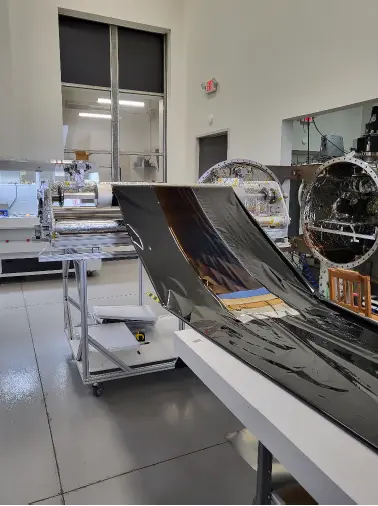
Overview: Starshade, Black Coatings & Stray-Light Suppression
Direct imaging of terrestrial exoplanets requires suppressing the host-star flux by roughly ten orders of magnitude relative to the planetary signal. External occulters, or starshades, achieve this suppression by geometric apodization, positioning a precisely shaped screen between the target star and a space telescope. System contrast is ultimately limited not only by the occulter's edge diffraction but by residual sunlight scattered from its surfaces and reflected from its optical edges. ZeCoat develops antireflection and high-absorptance ("black") coatings that minimize this scattered and reflected background from both the light-blocking membrane and the precision petal edges.
The Technology
The occulter presents two functionally distinct surfaces: a large-area flexible membrane and diamond-turned or etched optical edges that govern solar-glint performance. ZeCoat's coatings are engineered to maximize absorptance across the science band while controlling the bidirectional reflectance distribution function (BRDF) and thermal emissivity, allowing straylight and thermal-balance requirements to be satisfied within a single coating design. For large flexible membranes, roll-to-roll deposition provides uniform, scalable application, while radiation-hardened formulations preserve optical properties under the ionizing-radiation environment of long-duration missions. Broadband antireflection treatments applied to the optical edges reduce specular solar glint across the operational passband.